
The Sound of Progress: Why AI Music Is Just Music
- Apr 22
- 8 min read
From the hills of Tzfat, where artists have always embraced new ways to create
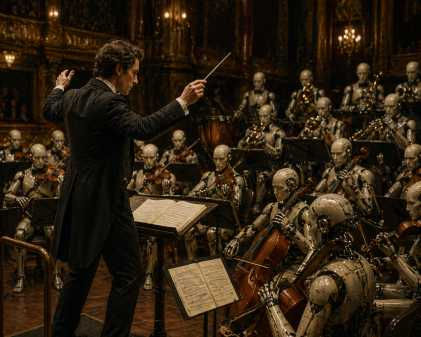
Every generation has its reactionaries. When Gutenberg's printing press began rolling out books by the hundreds, scribes warned that something sacred would be lost: the human touch, the devotion, the soul poured into every hand-copied letter. When power tools entered the furniture workshop, master craftsmen shook their heads and muttered that no machine could replace the feel of a hand plane guided by decades of instinct. And today, as AI music tools place the ability to compose, arrange, and produce in the hands of anyone with an idea and an internet connection, a familiar chorus rises again: it isn't real. It has no soul. Something is missing that you can't quite put your finger on.
You never could put your finger on it. That's the point.
A Tool Is a Tool
Let's be precise about what AI is, and what it isn't. AI is not a composer. It is not a record label. It is not a rival musician plotting against you in a studio somewhere. It is a tool. Sophisticated, yes, but a tool no less than the hammer, the printing press, or the electric saw.
And like every tool ever invented, it can be used well or poorly. A hammer can frame a house or break a window. A printing press can publish Shakespeare or propaganda. A power drill in skilled hands builds furniture that outlasts its maker; in careless hands it makes a mess. The tool carries no moral weight of its own. What matters is who picks it up, and what they intend to build.
AI music tools are no different. In the hands of someone with no musical sense, no feeling for rhythm, no ear for arrangement, they produce forgettable noise. In the hands of someone who genuinely loves music, who understands mood, pacing, texture, emotional arc, they produce music. Real music. Music that moves people.
The Mystical Objection
The most persistent argument against AI music is also the most conveniently unfalsifiable: that it lacks some ineffable, unmeasurable quality that only human suffering and struggle can produce. Call it soul. Call it authenticity. Call it whatever you like, the argument is always careful never to define it too precisely, because precision would expose it.
Ask the listener who was moved to tears by a piece of music, then learned it was AI-assisted, whether those tears were real. Ask whether their heartbeat actually slowed, whether the hairs on their arms actually stood up, whether the memory that surfaced was actually vivid. The emotional and physiological response to music is measurable. It either happens or it doesn't. No audience member has ever needed to know the production method to feel the music.
The claim that AI music lacks something mystical is not a musical argument. It is a gatekeeping argument dressed in philosophical clothing.
The Long History of "That's Not Real Art"
History is littered with the failed predictions of those who declared that new tools would hollow out human creativity.
The printing press, critics said, would make writing lazy and readers passive. Instead, it democratized knowledge, sparked the Renaissance, enabled the Reformation, and eventually put a book in the hands of every child on earth. The content of those books: their ideas, their stories, their arguments; was what mattered. Not the method of their reproduction.
Power tools in furniture making were supposed to destroy craftsmanship. Instead, they freed skilled makers from the most tedious and physically punishing parts of their work, allowing them to produce more, to focus their energy on design and detail, and to bring well-made furniture to people who could never have afforded handcrafted pieces. The master craftsman's eye, taste, and judgment remained indispensable. The tool simply extended their reach.
AI in music follows the same arc. It does not replace musical intelligence. It amplifies it. The person behind the music still makes every meaningful decision: the mood, the theme, the emotional journey, the arrangement choices, the mix. The tool handles the labor that previously required either years of technical training or tens of thousands of dollars in studio time.
Who It Actually Threatens
Here is something worth saying plainly, even if it is uncomfortable: a significant portion of the hostility toward AI music comes not from listeners, but from a specific subset of musicians: those who spent years, sometimes decades, chasing a level of success that never came.
The investment was real. The sacrifice was genuine. Years of practice, money spent on equipment and recording, rejection after rejection, the slow grinding realization that the industry is brutally selective and often arbitrary. That pain is legitimate.
But pain does not make a person right.
When someone who struggled for years to be heard watches a newcomer use AI tools to produce polished, emotionally resonant music without those same years of suffering, the reaction is human and understandable. It feels profoundly unfair. And so the argument becomes not "this music is bad" (because often it isn't) but "this music doesn't count." The goalposts shift to territory that can never be disputed: soul, authenticity, the mystical human element.
This is not music criticism. It is grief dressed as criticism. And while the grief deserves empathy, it should not be mistaken for a legitimate argument about the art itself.
The Copyright Argument That Proves Too Much
When the mystical objection fails to land, the conversation often pivots to something that sounds more legally serious: AI music tools were trained on existing music without the permission of the artists who made it. Therefore, the argument goes, every piece of AI-assisted music is built on theft, and anyone using these tools is complicit in that theft.
It is worth taking this seriously for a moment because the moment you take it seriously, it collapses under its own logic.
Every musician who has ever lived learned to play, compose, and arrange by absorbing the work of those who came before them. Not abstractly. Concretely. They listened to recordings — thousands of hours of them. They studied songs, internalized chord progressions, felt how a particular artist bent a note or delayed a beat. They copied. They imitated. They transcribed by ear. They played along until the patterns became instinct. And then, if they were talented and fortunate, those absorbed patterns began to recombine in their hands into something new.
Not one of those musicians asked permission. Not one of them paid a royalty for the right to let Miles Davis's phrasing work its way into their subconscious. Not one of them licensed the chord vocabulary of Joni Mitchell or the rhythmic sensibility of James Brown before allowing it to shape how they played. The entire history of music education: formal and informal, conservatory and garage; is the history of training on other people's material without consent.
This is not a scandal. It is how human culture works. It has always worked this way. Influence flows, accumulates, transforms, and re-emerges as something that belongs to the new creator. That is the mechanism of artistic tradition.
An AI music model does something structurally similar: it processes enormous amounts of existing music, identifies patterns, relationships, and structures, and learns to generate new material informed by what it has absorbed. The scale is different. The speed is different. But the underlying process of learning from what exists in order to produce something new, is the same process every musician has always used.
Those who invoke copyright in this argument are not, in most cases, primarily concerned with the legal nuance of training data and model weights. They are using the language of rights to do what the mystical argument could not: give the rejection of AI music a respectable, enforceable face. It is the same impulse in a suit and tie.
The musicians whose work fed into these models were themselves fed by the unconsented generosity of every musician who came before them. That is the deal culture has always made with itself. Calling it theft only when the learner is a machine, and not when the learner is a human, is not a principled position. It is a convenient one.
The Label as a Weapon
There is another tactic worth examining: one that operates not through argument, but through pre-emptive steering. Increasingly, platforms and industry bodies have begun labeling music created with AI tools, flagging it before the listener has heard a single note. The stated justification is transparency. The actual function is something else entirely.
Consider what the label does in practice. It does not tell you whether the music is good or bad, moving or flat, well-crafted or careless. It tells you nothing about the music at all. What it does, by design, is prompt a certain category of listener to avoid it before forming any opinion of their own. The label is not informational. It is directional. It says: this is the kind of thing you probably don't want.
This is a familiar mechanism, and it has a name outside the music industry. When products from certain regions are labeled specifically to make them identifiable for boycott, not because anything is wrong with the products themselves, not because their quality is in question, not because the consumer has any direct grievance with the thing being sold, the label is a political instrument. It has nothing to do with the orange, the wine, the piece of software, or the garment. It has everything to do with using consumer behavior as a lever for an ideological agenda, one that serves whoever controls the labeling standard.
The parallel is exact. AI music labels do not protect consumers from bad music, there are no shortage of platforms already drowning in terrible music made entirely by humans. They protect an incumbent class of producers, labels, and gatekeepers from competition they cannot defeat on musical merit alone. The label manufactures a reason to reject before listening, which is the only way to win an argument you cannot win on the actual evidence.
And just as product boycotts rarely hurt the intended ideological target while reliably hurting the workers, farmers, and small producers who had nothing to do with any political dispute, AI music labels most directly harm the independent, low-budget creators, the ones in small cities, in overlooked countries, without industry connections, for whom these tools represent their only realistic path to being heard. The major labels and well-resourced studios will adapt and absorb AI regardless. They always do. The label lands hardest on exactly the people democratization was supposed to help.
Transparency that only flows in one direction is not transparency. It is a checkpoint.
Accessibility Is Not a Scandal
For most of recorded history, making professional-quality music required either extraordinary wealth, access to gatekeepers who controlled that wealth, or both. A full studio session, professional musicians, mixing and mastering engineers, distribution; the costs were staggering. Entire genres of music existed, were heard and loved, and then vanished because the people who created them could not afford to preserve or distribute them properly.
AI music tools have changed that equation fundamentally. A composer in a small apartment, in a small city, in a country far from any major music industry hub (perhaps, say, in the ancient mystical hills of Tzfat in northern Israel) can now produce music of genuine quality without a major label contract or a production budget. The idea, the feeling, the musical vision: these are what the creator brings. The tool handles the rest.
This democratization is not a threat to music. It is music's greatest expansion since the invention of recording itself. More voices. More perspectives. More music reaching more people.
Those who call this a dilution of quality are, in almost every case, the same people who were already inside the gate.
The Music Is What It Is
Strip away the arguments. Forget the production method. Forget who made it, how, and with what tools.
Press play.
Does it do what music is supposed to do? Does it create an atmosphere, sustain a mood, carry you somewhere you weren't before you started listening? Does it make you feel something? anything? Does the melody stay with you after it ends? Does it fit the moment it was made for, whether that's a quiet evening, a creative pause, a long drive, or a moment of unexpected emotion?
If yes then it is music. Full stop.
The printing press did not diminish words. Power tools did not diminish craftsmanship. And AI does not diminish music. It simply means that more people, with more ideas, from more places, can now add their voice to the great ongoing conversation that music has always been.
The reactionaries will catch up eventually. They always do.
Until then, listen. Judge with your ears and your heart, the only instruments that have ever really mattered.


Comments